
Bowthorpe Oak
Great British Trees #5

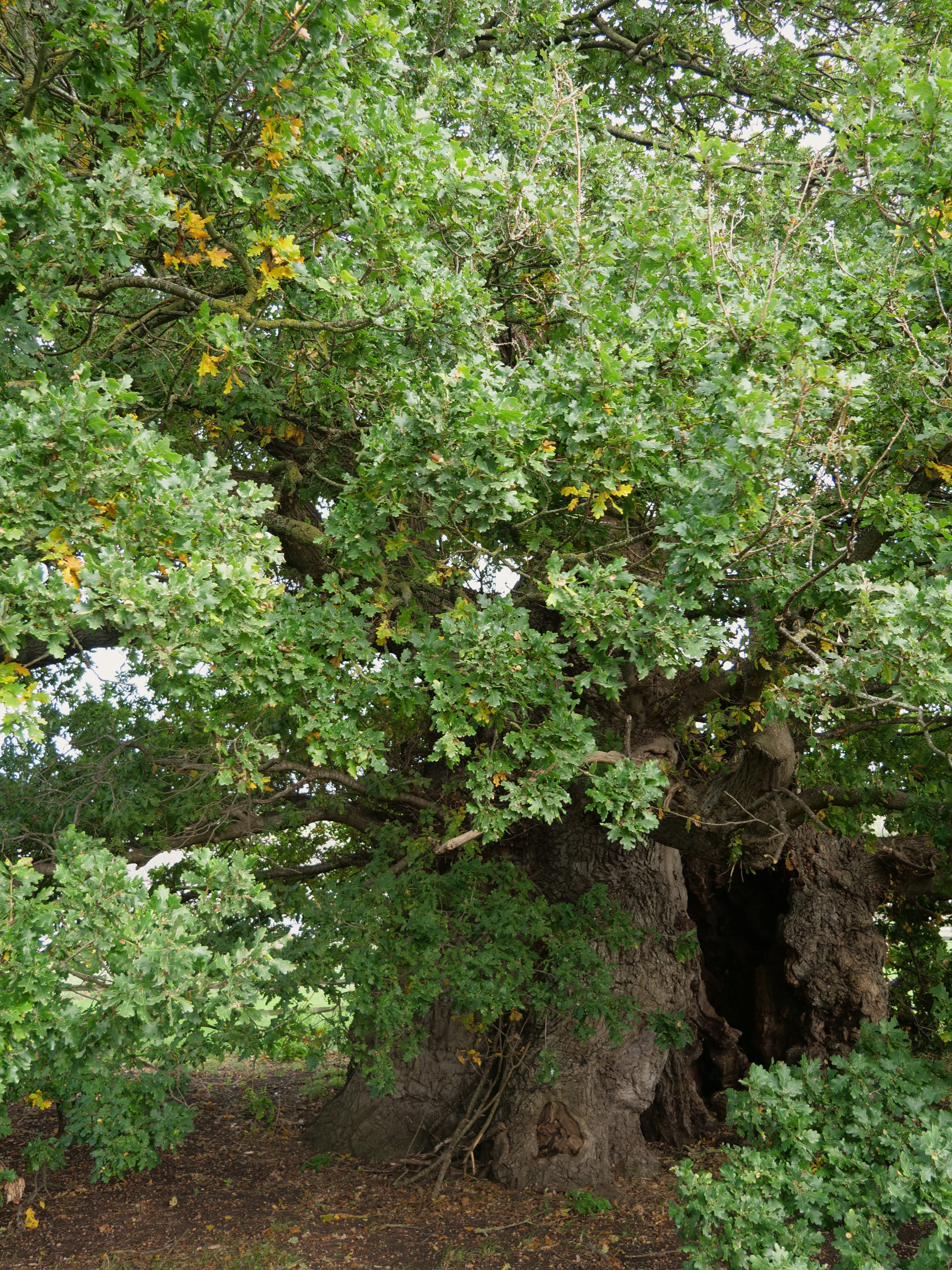
“Hello, we’d like to see your tree, please.”
“Sure, that’ll be £2.50.”
The farm shop charges visitors a small fee to visit the Bowthorpe Oak. It might at first appear strange — against the spirit of it, even — but I struggle to begrudge them such a small amount. It is sweet that the farmers take such pride in their remarkable tree and that the small community of visiting tree enthusiasts are able to support a local business in the process. It is a shame, however, that the Bowthorpe Oak now stands inside a large gated enclosure.
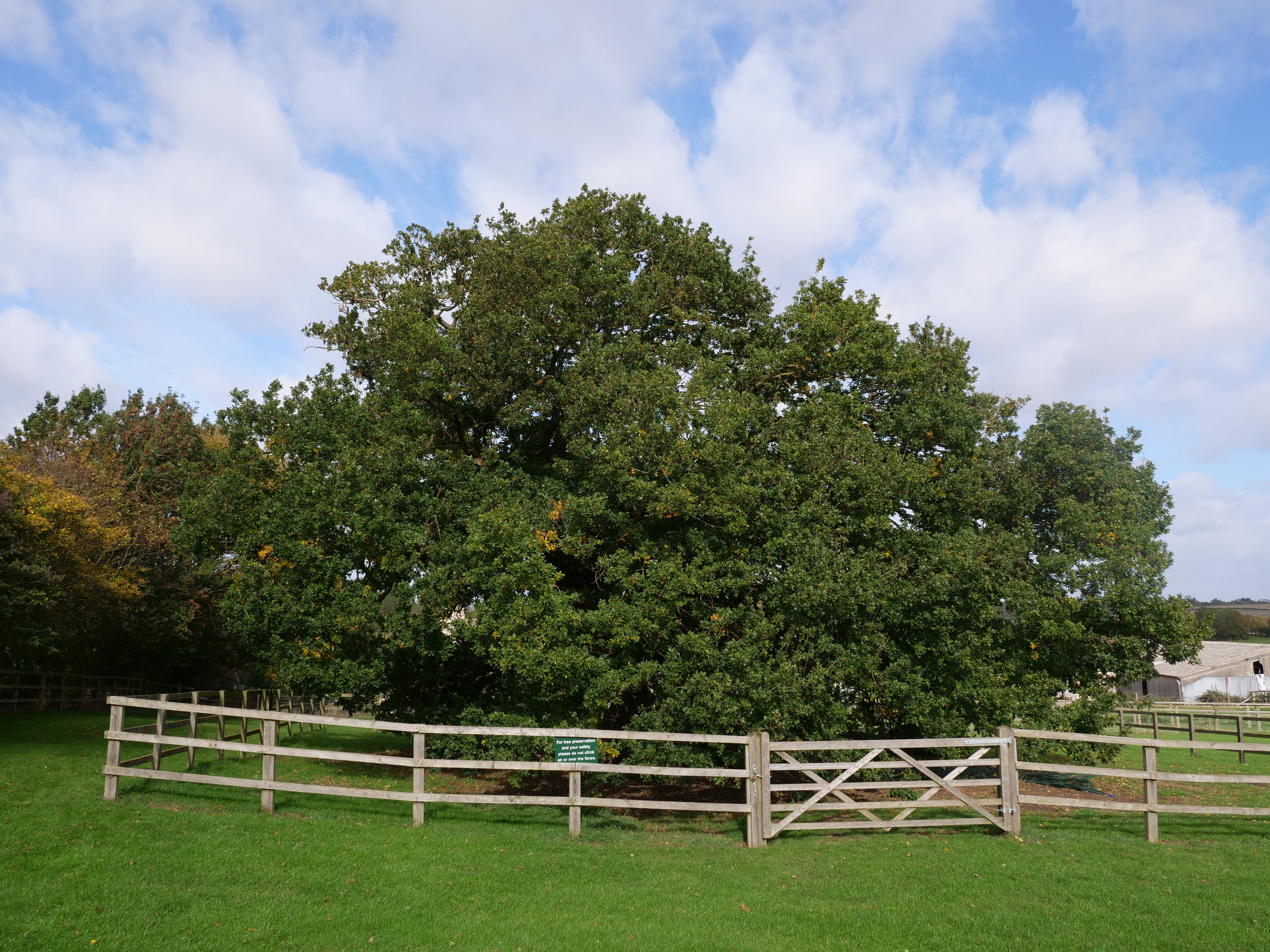
Ostensibly, this is in order to protect the tree from the effects of soil compaction. After decades of visitors clambering all over it, this ancient tree is finally beginning to feel its age. It is, after all, over a thousand years old. In recent years, the Bowthorpe Oak has shrunken and started, ever so slowly, to fall in upon itself. Recently, a huge branch came crashing down at the back. “Our CCTV wasn’t working that day”, says the farmer at the till. “It’s a shame, really.”
That the Bowthorpe Oak is now being cared for so diligently is certaintly a good thing. Although, if you book in advance, you can pay a little extra for a private tour. At the right price, visitors are still able to go right up to it. There, they are able to see the remains of a pigeon loft, built by a previous owner, and trace their fingers over the ancient graffiti carved into its fissured bark.
Previous guests were clearly not so careful. Like the Crowhurst Yew in Surrey, the Bowthorpe Oak was once hollowed out and fitted with a dining table. It too was used for parties, boasting the ability to accommodate twelve people sat down or nearly forty people stood up. A door was later nailed to the outside and, when its party days were over, the Bowthorpe Oak became a calf shed — or a “bull oak”, as these trees were sometimes called. Until recently, chickens still pecked their way around it. Sheep still sheltered here from the rain. But, now, no longer. Leaning along the wooden fence, guests today try to peep through the leaves and peer under the branches.
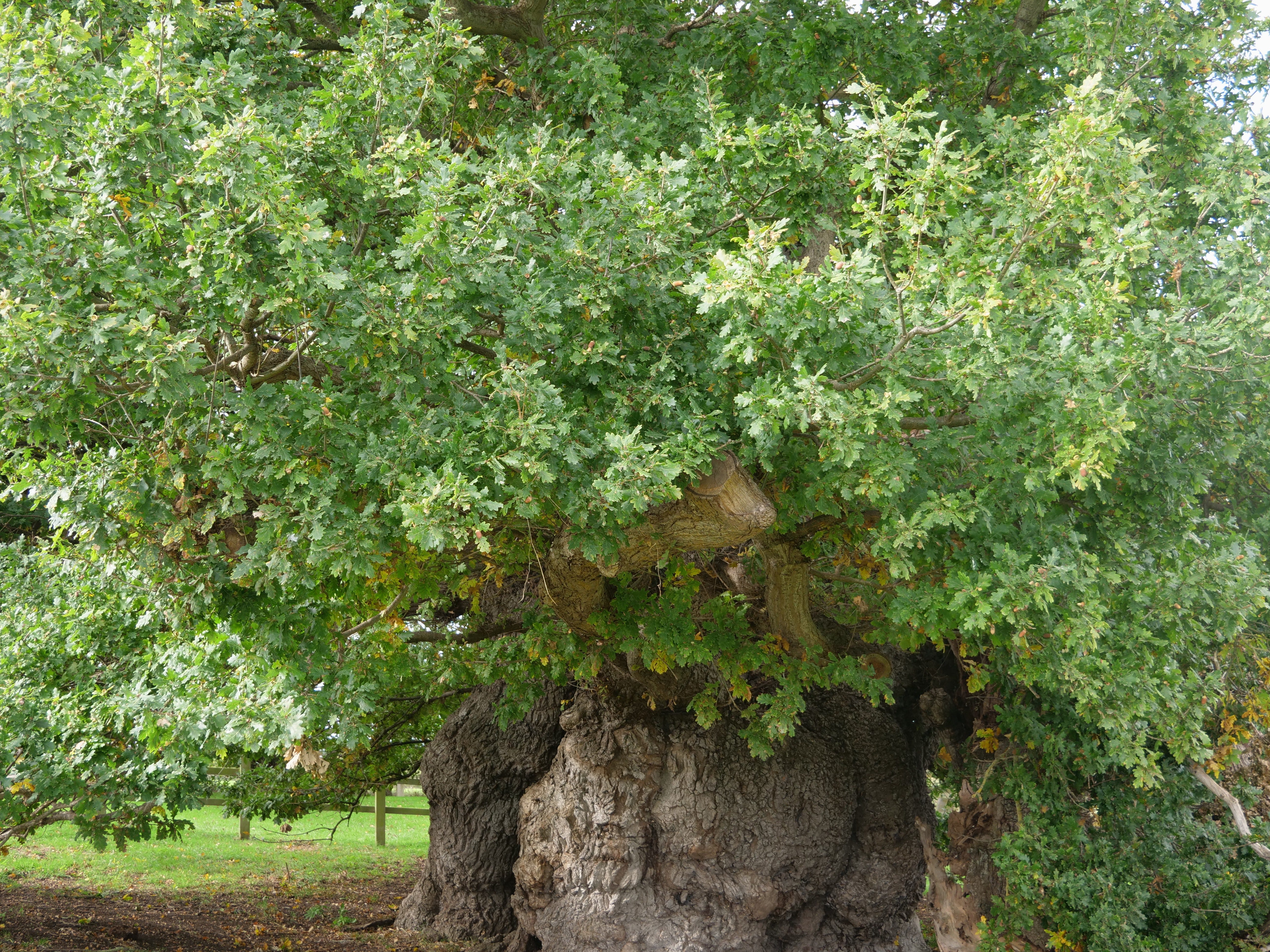
The Bowthorpe Oak claims to be Britain’s largest girthed oak tree, but it is hard to tell so under its thick, green plumage. In Autumn, most of the trunk is still swamped by leaves. The parts you can glimpse appear lost, somehow. Set back and receding. But the base — looming large below this vast mass of nature — is dense and monumental. It emerges, fat and carbuncular. A behemoth, hiding in plain sight.
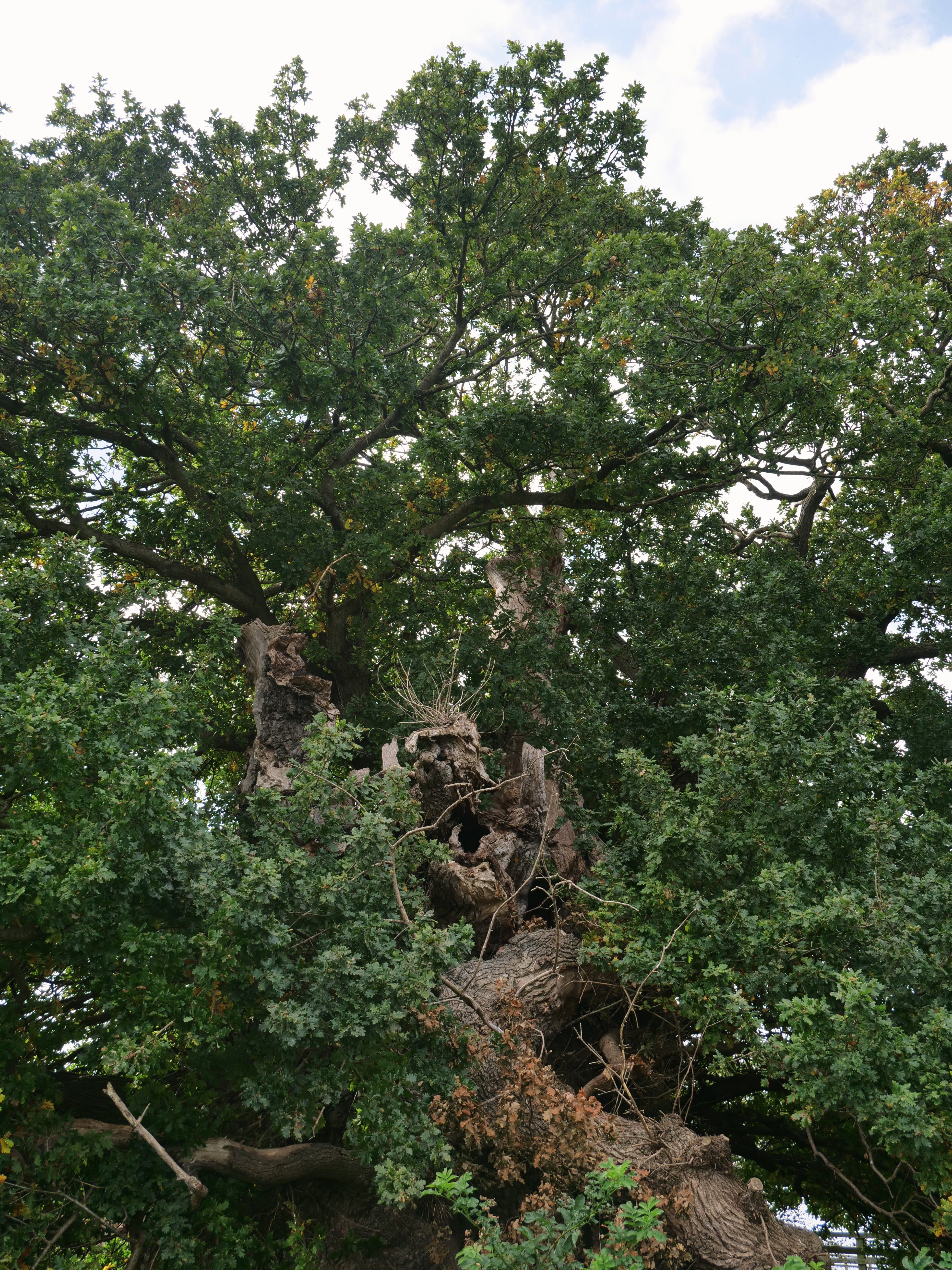
The Bowthorpe Oak is almost certainly a pollarded oak, meaning that it was cut back repeatedly over many centuries, allowing livestock to graze and shelter below it and new branches to grow just out of reach. This means that, whilst the Bowthorpe Oak does not have the large crown of many other ancient oaks, its trunk is enormous and burred. A squat, sleeping giant. It is common for pollarded oaks, after the practise of pollarding has ceased, to experience a sort of gentle atrophy, for their massive and unsupported limbs to die back or to come crashing down in a storm. In ancient oaks such as this one, it is also possible for younger branches to grow around a dead and decaying frame, meaning that parts of the Bowthorpe Oak are both dead and alive at the same time. A kind of vibrant, patchy decline.
Still, I cannot shake the feeling that there is something melancholic about this grand, old tree stranded in its oversized, wooden pen. It is easy to assume that years of constant use have brought it to this stage, that were I able to walk up to it and clamber inside of it, I would feel differently. But the peasant poet John Clare had already described something similar in the nineteenth century. “Old noted oak”, he wrote, “thou hermit, in the lonely sea of grass that waves around thee.” For John Clare, this ancient tree — “shattered to a stump” — had become an obvious symbol of decay. If he wrote that in the nineteenth century, then wasn’t I justified in thinking so now? And yet, two centuries later, here it is. The Bowthorpe Oak is still standing. Still flourishing. Still growing new branches. It is hard to reconcile my feelings of melancholy with such a healthy, thriving exterior. Was it, I wondered, not the tree that was melancholy at all? Was it me?
I stare at the fence, annoyed.
Remarkably, Britain has more ancient oaks than the rest of Europe combined; indeed, over half of the ancient oaks alive in the world today are growing in Britain. There are, by some estimates, over seven hundred named oak trees in Britain; there’s the Dickens Oak in Essex, the King of Limbs in Savernake and of course there’s the Druid’s Oak at Burnham Beeches. But why does Britain have so many ancient oaks? Is our soil simply better than other European countries? Are our trees spurred on by nationalistic pride? No, of course not, but the answer has more to do with fences — or, rather, with ownership — than you might think.
Much of the ancient oaks that we still have growing in Britain are stood on the sites of Royal Forests and ancient deer parks, meaning that they escaped being turned into timber and were primarily used for grazing and for hunting. Royal Forests provided restricted access for commoners, softened further by the Charter of the Forest in 1217, but medieval deer parks were often fenced off to prevent deer from escaping. A large number of ancient oaks were also associated with manor houses, meaning that they once belonged to the lord of the manor and were also restricted for commoners. Aljos Farjon, in his comprehensive guide Ancient Oaks in the English Landscape, lists the Bowthorpe Oak as belonging to this category of oak.
But was there ever a manor house at Bowthorpe? It is hard to say for sure. According to the Domesday Book, the folk hero Hereward the Wake held land around Manthorpe which is said to have once included Bowthorpe Park. If this is true, then the area around the Bowthorpe Oak may well have been part of the land that was stolen from Hereward by the Normans; it is said that Hereward the Wake returned to these lands to discover his younger brother had been killed by the invaders, his head displayed on a bloody spike. From then on, Hereward became a travelling bandit, a rebel leader with no fixed abode. “Then Hereward swore a great oath, by oak and ash and thorn,” writes Charles Kingley in Hereward the Wake, “that he would neither eat bread nor drink water, while there was a Norman left in Bourne.” Bourne Castle, the Norman castle built by Baldwin FitzGilbert is said to have stood on the same site as Hereward’s old manor house until it was destroyed by Oliver Cromwell’s troops in the English Civil War.
Must we therefore thank the hunters, the nobility, the colonialists and their ilk for the protection of these beautiful trees? Perhaps in part. Other writers have argued that another point of difference with the rest of Europe was that British landowners centuries later were often so wealthy from the spoils of the British Empire that they did not feel the need to exploit their land so ruthlessly. But further privatisation was certainly not a friend to the English Oak. The tragedy of the commons — specifically, the Enclosure Acts throughout the eighteenth and nineteenth centuries — saw thousands of oak trees cut down to make way for intensive farming. Thousands more were cut down for timber. Chaucer called oak the “byldere oak”, and so too did Spenser: “The builder-Oake, sole king of forests all.” For many centuries, oak was the favoured tree for ship-building, but it was also the most expensive. A symbol of power, in every sense. As John Lewis-Stempel writes, “It was oak that made the ‘wooden walls’ of Nelson’s navy, and it was the navy that allowed Britain to rule the world. Oak was charcoal for smelting in the first foundries of the Industrial Revolution, the axle for the Haywain, tannin for lather, shelter for livestock, shade for the courting couple.”
So, perhaps, there was always a fence around the Bowthorpe Oak. And perhaps this too is what unsettled John Clare, who Elizabeth Helsinger has described as searching for the “remnants of unowned land in an enclosed landscape.” As he saw wealthy landowners transform the landscape that he had once called home, John Clare realised that the only place where the wilderness now survived was in his poetry. In his childhood, he recalled a diverse mixture of woodland, meadows, fen, and common land; but as he grew up, he saw it all enclosed, carved up, and fenced in. In another poem, The Round Oak, Clare describes an oak tree that once grew by a stream but that was cut down for an enclosure. Other poems, To a Favourite Tree and To A Fallen Elm tackle similar themes. “I loved thy shade once”, he writes, “now I love but thy name.” In later life, John Clare was admitted to an asylum in Epping Forest — he felt a profound sense of dislocation, of alienation. “Enclosure came and trampled on the grave”, he writes bitterly, “Of labour’s rights and left the poor a slave.”
In the next field along, a llama tries to jump over a metal gate. A failed bid for freedom. But the Bowthorpe Oak does not move. It stands, chained, penned in, split down the middle. An unknowable, dark gap in the centre of the field.
I try to stop thinking about the fence. I must stop thinking about the fence.
I walk around the tree, several times, admiring its profound beauty. Its “picturesque decay”, as John Clare would put it. A nearby information board announces: “The greatest time of year is when the Bowthorpe Oak comes into leaf, each year this spectacular display marks the end of winter.” As I read on, I wonder whether perhaps we are here at the wrong time of the year. Perhaps we should have come in the Winter, when the leaves have all fallen and the view is clear. Or perhaps we should have come in the Spring, when the sun is shining and the lambs are frollicking in the farm. “At the other end of the year”, the information board continues, “is the sign of winter to come when the tree produces acorns.”
I look down and, for the first time, notice all the fallen acorns. Resting there, patiently. Nestled in the grass. There are hundreds of them. I bend down and pick one up. I turn it over in my hands.
It is still possible, I realise, to escape the fence.
More photos:




Over the course of many years, I am hoping to visit all fifty trees on the Tree Council’s list of Great British Trees. This is the fifth. Thanks for reading and much love to everyone resisting fossil capitalism whoever and wherever you are.